- National land clearing estimates range from about $1,200 to $6,000 or more per acre, depending on vegetation. These are reference figures, not Arkansas-specific quotes.
- Tree size, vegetation density, and debris handling are major factors in the final cost.
- You rarely need to clear an entire property to build a home. Focus on the house pad, driveway, utility routes, and septic area if needed.
- Arkansas requires advance notice to the state forestry agency before burning forest vegetation, including land-clearing debris.
- Have your builder evaluate the property before setting your site-preparation and construction budget.
A wooded lot can look like the perfect place to build a home. Before you move forward, though, you need to know how much of it must be cleared. The land clearing cost per acre depends on the size and density of the trees and brush, the terrain, access to the property, and how the contractor handles the debris.
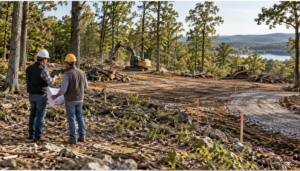
When we look at a property, we first consider what needs to come down for construction. That usually includes the house pad, driveway, utility runs, and enough room for equipment to work. If the home will use a septic system instead of city sewer, the planned drain field area also needs to be considered. You may not need to clear the entire lot. The clearing plan should reflect where your home and essential site features will go.
How Much Does Land Clearing Cost Per Acre?
The land clearing cost per acre depends on the vegetation covering your property. According to OWNR OPS, national estimates range from $1,200 to $2,500 per acre for light brush and $3,500 to $6,000 or more for heavy timber. These are national and regional contractor estimates, not quotes for properties in Arkansas.
| Type of vegetation | National cost per acre |
|---|---|
| Light brush | $1,200–$2,500 |
| Medium vegetation | $2,000–$3,500 |
| Heavy timber | $3,500–$6,000+ |
The OWNR OPS land clearing guide also provides Southeast regional estimates. The range is $1,000 to $2,000 per acre for light vegetation, $1,800 to $3,000 for medium vegetation, and $3,000 to $5,000 for heavy vegetation. Arkansas falls within this region, but these figures do not establish what a contractor will charge to clear your specific property.
For residential lots between 0.25 and 1 acre, OWNR OPS estimates total clearing costs of $3,000 to $8,000. Many contractors also set minimum charges of $1,500 to $3,000, even for smaller jobs.
When we assess a property for a custom home, we look beyond its total acreage. A lot with light brush requires different work from one covered in dense trees and stumps. The amount of debris that needs to be hauled away also affects the estimate. Your actual cost depends on the vegetation, clearing requirements, and work needed to prepare the homesite. We need to assess the property before determining how much land must be cleared for construction.
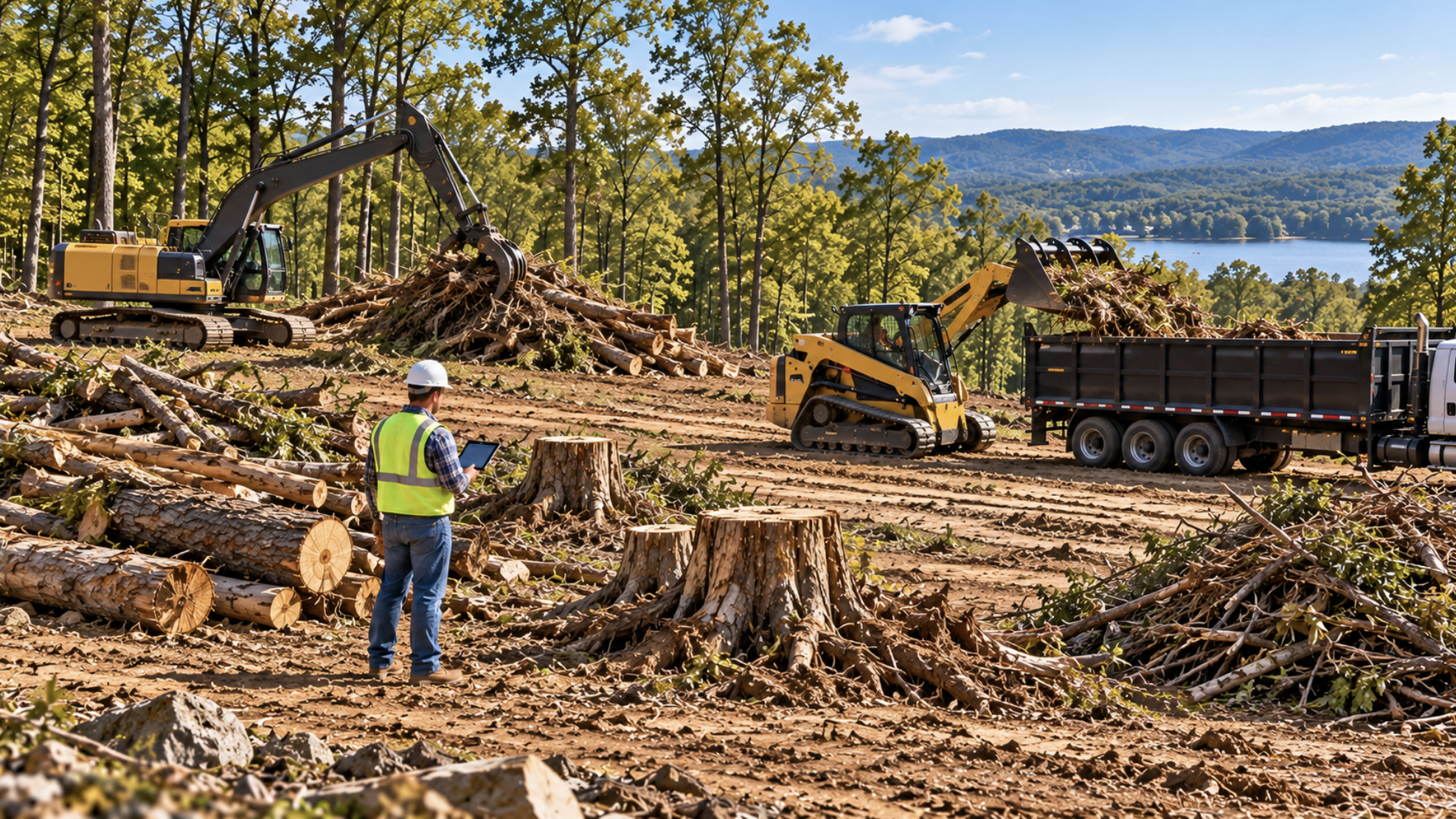
What Changes the Price?
Trees and Brush
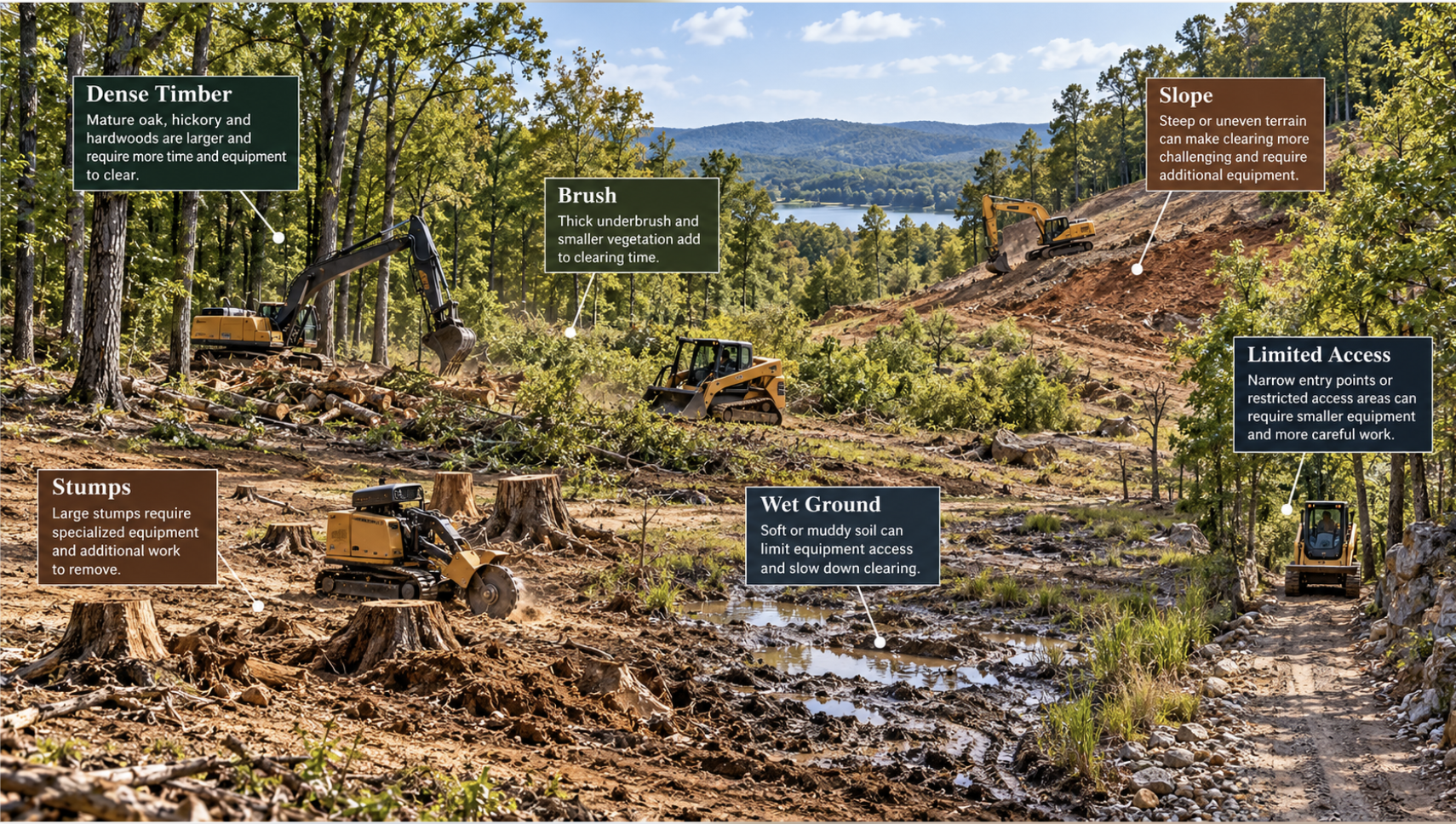
The trees and brush on your property affect how much work it takes to prepare the land. Scattered brush is usually easier to clear than an area covered in dense timber. According to OWNR OPS, hardwoods such as oak and hickory take longer to clear than pine. Heavily forested land also requires more equipment time and leaves more material to handle.
The vegetation and the areas that need clearing for your home help determine the scope of the work. The amount of clearing depends on what is actually on the land, not just its total acreage.
What Happens to the Debris
Once the trees and brush are removed, the debris still needs to be handled. A contractor may mulch it in place, pile it for burning where permitted, or haul it away. Each option involves different work and equipment.
Southeast Texas contractor Daniel Dean provides an example of how debris removal affects the price. For one acre, his listed rate is $5,800 when debris is bladed off and $11,000 when it is hauled away. That is a $5,200 difference. These are his own Southeast Texas rates, not Arkansas prices. Before work begins, ask your contractor what happens to the branches, logs, and brush left after clearing.
Stumps
Stump grinding and complete stump removal are not the same. Grinding cuts a stump down, while full removal takes out the stump and its major root system. OWNR OPS estimates stump grinding at $150 to $500 per stump.
Stumps in your home’s foundation area need to be removed before foundation work begins. Their number, size, and location help determine how much work the crew must do.
Slope, Access and Wet Ground
The condition of the property also affects how equipment can move across it. Steep slopes, soft or wet ground, and limited access can make clearing slower. These conditions may require more time and careful equipment operation.
The terrain and equipment access are also part of planning the site preparation. Along with the trees, brush, and stumps, these conditions help determine what needs to happen before construction can begin.
What You Actually Need to Clear to Build a House
A wooded lot in Central Arkansas may have more trees than your home and driveway require. You do not automatically need to clear every acre. The clearing plan should follow the location of your house, driveway, utilities, and septic system, if needed.
Start with the house pad, the area where your home’s foundation will sit. This area must be cleared before foundation work can begin. Your driveway also needs a clear route from the road to the homesite so construction crews and equipment can reach the property.
Next, account for the utility runs. These may include connections for water, electricity, and other services available at the property. Their locations affect where clearing is needed. Your builder should also account for the space required to bring construction equipment onto the site and work around the house pad.
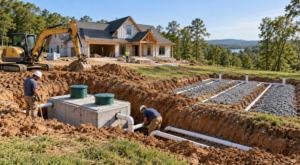
If your lot is not connected to city sewer, include the planned septic system and drain field area. Heavy brush or overgrowth may need to be cleared so the area can be accessed for a soil evaluation. Silver Field’s guide to the perc test for land in Arkansas explains this step in more detail.
These areas determine much of the cost to clear land for a house. Clearing a homesite is different from removing trees and brush across an entire property. Trees outside the house pad, driveway, utility routes, and required septic area may be preserved if they do not interfere with construction.
Before clearing begins, have your builder identify these areas on the site plan. That gives you a clearer picture of what must be removed and what can remain.
Burning Clearing Debris in Arkansas
If your land-clearing contractor plans to burn brush, tree limbs, stumps, or other forest debris, Arkansas law requires advance notice. Under Arkansas Code § 20-22-302, anyone burning forest vegetation, including debris from land clearing, must notify the state forestry agency before the burn. The notice must include the time and location. The landowner or person in charge must also be present during the burn.
Arkansas Code § 5-38-310 prohibits burning brush, stumps, or logs without taking the necessary precautions. An active burn ban can also prohibit outdoor burning, even when the required notice has been provided.
Yard waste has separate rules. The Arkansas Department of Environmental Quality states that open burning of yard waste is strongly discouraged but permitted in some areas. Local authorities may impose additional restrictions.
Before your contractor burns clearing debris, confirm the current state notification requirements, local rules, and any active burn bans. If burning is not permitted, discuss other options, such as mulching the debris or hauling it away.
How Clearing Fits Your Build Budget
Land clearing is a separate site-preparation expense. It is not included in Silver Field Construction’s standard home plan pricing. The company’s custom home floor plans and costs page states that plan prices assume a “slab foundation for 1′ elevation difference (very flat lot)” and “connecting to city/county utilities within 50′ of house.”
Properties that do not meet these assumptions may require additional site work. Silver Field explains how it handles those costs:
“We will however inspect your land and provide estimated cost for clearing, driveway, utilities (septic/well too), old structure removal, and anything else required get the land ready to build on.”
This means clearing is estimated based on the actual property after a land visit. It is not assigned a standard rate or automatically included in the home’s construction price.
For the home itself, Silver Field Construction’s pricing starts at $150 per square foot. Typical projects range from $160 to $200 per square foot, with most falling between $170 and $190 per square foot. The minimum build budget is $300,000.
These figures cover the home construction budget, not clearing, driveway work, utility connections, or old-structure removal. Silver Field also offers full floorplan design and floorplan modification as part of the home planning process.
Before You Buy a Wooded Lot
Before you buy a wooded lot, walk the property with your builder. Look at where your home could sit, how the driveway would reach it, and what needs to be cleared. The asking price does not show what it will take to prepare the land for construction.
Use this checklist before you commit:
- Walk the lot with your builder. Discuss the house pad, driveway, and areas that need clearing.
- Call 811 before digging. Have underground utilities marked before excavation begins. LawnStarter notes that this service is usually free.
- Check sewer or septic access. Find out whether the property can connect to city or county sewer or needs a septic system and drain field.
- Ask about the timber. Find out whether the trees have potential value before arranging removal. Do not assume timber sales will cover clearing costs.
- Get the clearing scope in writing. Confirm which trees, brush, and stumps will be removed and whether the debris will be mulched, burned where permitted, or hauled away.
Our guides to finding land for your custom home and building on rural vs urban land cover other factors to consider when choosing your property.
Land Clearing Cost FAQS
How much does it cost to clear 1/2 acre of land?
According to OWNR OPS, clearing half an acre costs $800 to $1,500 for light brush and $2,500 to $4,500 for heavy timber. Smaller jobs can cost more per acre because many contractors set minimum charges of $1,500 to $3,000.
How much does it cost to clear trees from land?
Tree size and debris handling affect the clearing cost. LawnStarter estimates $3,395 to $6,155 per acre for heavily forested land, while OWNR OPS estimates stump grinding at $150 to $500 per stump.
Do I have to clear my whole lot to build?
No. Your homesite needs room for the house pad, driveway, utility runs, and septic drain field if the property does not connect to sewer. The clearing plan should identify which areas need to be cleared for construction.
Can I burn the debris from clearing my land in Arkansas?
Under Arkansas Code § 20-22-302, you must notify the state forestry agency before burning forest vegetation, including land-clearing debris. The landowner or person in charge must be present, and burning is subject to active burn bans.
Is land clearing included in the cost to build a house?
No. Silver Field Construction’s standard plan prices assume a very flat lot with a one-foot elevation difference and city or county utilities within 50 feet of the house. After inspecting your property, Silver Field estimates the cost of clearing, driveway work, utilities, septic or well service, and old-structure removal.
Clearing is a separate site-preparation expense to account for when planning your custom home. Review our guide to land clearing to understand the factors that affect the work and cost of preparing your property.
Before you buy a wooded lot in Central Arkansas, have Silver Field Construction walk the property with you. We can review the proposed house location, driveway access, utility connections, and septic requirements. This helps identify the clearing and site-preparation work your property may need before you commit to the purchase. Have us walk your lot and discuss your plans with our team.